
Lisbon-Lemon-Tree-Care
Written by webtechs

Lisbon Lemon Tree Care

LISBON LEMON TREE CARE

GET A FREE ESTIMATE TODAY!

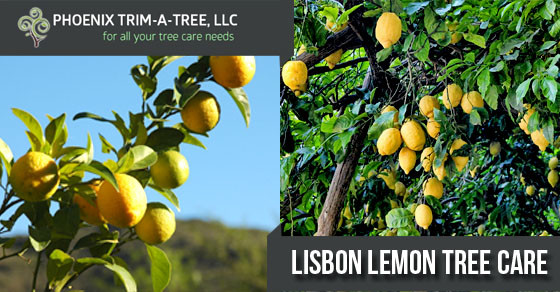
Lisbon lemon trees are quite popular in Arizona. Lisbon lemon trees can tolerate harsh heat and windy conditions but are somewhat “frost sensitive”. Luckily Arizona doesn’t get must frost, so planting and harvesting a Lisbon Lemon tree in Arizona is very possible and with the right tree care your lemon tree can grow up to 30′ tall. So, get ready for Lisbon Lemon tree care tips from the experts at Phoenix Trim A Tree.

PLANTING YOUR LISBON LEMON TREE

Make sure and plant your Lisbon lemon tree in a area where it can receive full sun. Soil should drain easily as lemon trees do not grow well in standing water. If you live in a colder part of Arizona, such as Flagstaff, you are going to want to grow your lemon tree in a container that can be moved inside your home during the winter months.

HOW MUCH MULCH DO I NEED FOR PLANTING?

The root zone should be buried in 4-6″ of mulch. Mulch will reduce the amount of moisture loss and reduces the amount of weed grown around the base of the tree.

LISBON LEMON TREE CARE

Lemon trees need sun, water, fertilizer and pruning just like every other plant. Read about how to water your lemon tree, protect them from the cold, fertilize them, and how to prune and harvest your lemons.

HOW OFTEN SHOULD I WATER MY LEMON TREE

Lisbon lemon trees need to be watered regularly, especially during the first 3 years, or their 1st growing season as experts would call it.

WATERING DURING THE SUMMER – Water your Lisbon tree once a week during the summer months.

WATERING THE REST OF THE YEAR – For the rest of the year, only water your lemon tree every other week.

WATERING AFTER THE FIRST YEAR – You can reduce the amount of watering after the first year to prevent over watering.

LEMON TREE FEEDING/FERTILIZER

Lemon trees in general need a hefty supply of food (nutrients) to have healthy growth. Although, you won’t use a general fertilizer for Lisbon trees, you are going to want to use a citrus fertilizer that is made for citrus trees. You should re-fertilize your tree 2-3 during the growing season. The first re-fertilization should take place in spring. You’re going to want to fertilize before the new growth comes, not after, and then again at the beginning of September. If you are growing your lemon tree indoors, you are going to want to re-fertilize every month during the hot months to keep the soil moist and rich.

LISBON LEMON TREE PRUNING

STEP 1 – Choose the proper time to prune
STEP 2 – Remove all fruit from the tree
STEP 3 – Prune any branches that are damaged or diseased all the way back to the base
STEP 4 – Cut any branches that are smaller than the diameter of a pencil
STEP 5 – Prune suckers as they appear at any time

Usually, trees are only pruned during their dormant periods but lemon trees don’t have one. So, you should only prune or shape your Lisbon lemon tree during the cold months while the tree growth has slowed. Also, any suckers on the trunk of the tree should be removed. Also, to produce larger lemons, pinch off excess lemons while they are still tiny and leave 4-6″ between them. Read Wiki How’s Article on “How To Prune A Lemon Tree: 12 Steps (with Pictures)” for more information about pruning your Lisbon lemon tree.

PROTECTING YOUR LEMONS FROM THE COLD

As we learned above, Lisbon trees are sensitive to frost. Cold temperatures are one of the only things that can kill your Lisbon tree. Use Christmas lights strung through a canopy to provide extra heat during the cold months. For the coldest months, you can wrap your canopy in a blanket for additional heat.

HARVESTING YOUR LEMON TREE

Lisbon trees usually produce fruit within 3 years of planting.

IN CONCLUSION

  • Plant Your Lemon Tree In A Sunny Area With Good Drainage
  • Plant Your Lemon Tree in 4-6 inches of mulch
  • Water your lemon tree every week during the summer months and every other week after that
  • Feed your lemon tree nutrient rich citrus fertilizer
  • Only prune your Lisbon tree during the winter months
  • Protect your lemon trees from the cold, it’s the only thing that can kill them

Thank you for reading “Lisbon Lemon Tree Care” by Phoenix Trim A Tree. If you haven’t done so already, make sure and check out our post “Growing Lemon Trees In Arizona” for more information.
LISBON LEMON TREE CARE SERVICES

What-Is-Tree-Trimming-Tree-Pruning-Definition
Written by webtechs

What is Tree Pruning? – Tree Pruning Definition

WHAT IS TREE PRUNING? – TREE PRUNING DEFINITION

GET A FREE ESTIMATE TODAY!

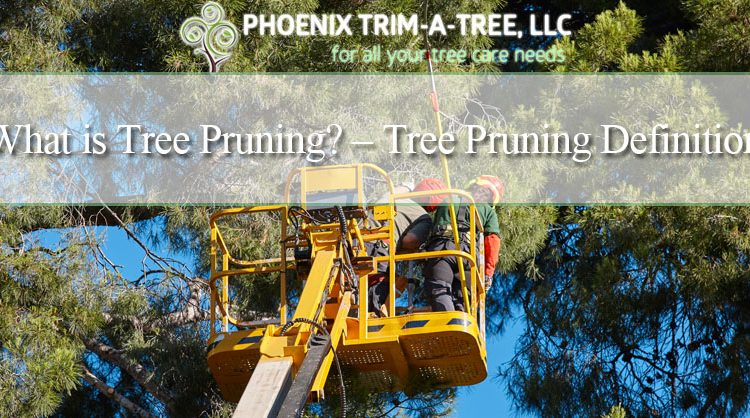
TREE PRUNING DEFINITION – Pruning is a horticultural practice comprising of the selective removal of certain parts of a tree, such as roots, branches or buds.

REASONS TO PRUNE

Because each cut can change the overall growth of the tree, no branch should be removed without grounds to be cut. Typical reasons for pruning are for the removal of dead branches, to enhance form, and to reduce risk of falling branches. Trees can also be pruned to let in more light and air penetration to the tree’s crown or to the landscape below the tree. In some cases, mature trees are pruned as preventive or corrective steps, as regular thinning does not actually improve the health of a tree.

WHEN TO PRUNE

Most regular pruning to remove disease-ridden, weak or dead limbs can be completed at any time of the year with little impact on the tree. In general, wound closure and growth are increased if pruning takes place prior to the spring growth flush. A couple of tree diseases, like oak wilt, can develop when pruning wounds and can provide access to pathogens. Vulnerable trees should not be pruned in active transmission spells.

PRUNING TECHNIQUES

Certain types of pruning may be necessary to manage an adult tree in a healthy, safe, and appealing condition.

CLEANING – Cleaning is removing dead, dying, diseased-ridden, weakly joined, and low-strength branches from the crown of the tree.

THINNING – Thinning is selective branch removal to improve the tree structure and to increase light penetration and air movement throughout the crown. Correct thinning opens up the foliage of a tree, lessens the weight on more substantial limbs, and helps keep the tree’s natural shape.

RAISING – Raising removes lower branches from a tree to allow clearance for buildings, vehicles, and people.

REDUCTION – Reduction reduces the size of a tree, usually for utility line clearance. Reducing a tree’s height or spread is generally done by pruning back the tree leaders, and branch ends to secondary branches that are sufficiently large enough to take over the terminal roles. In comparison to topping, reduction helps keep the form and structural durability of the tree.

PRUNING YOUNG TREES

Proper pruning is vital in developing a tree with a robust structure and appealing form. Trees that receive proper pruning measures while they are still young will need fewer corrective pruning as they grow older. A sturdy structure of primary branches should be created while the tree is still young. These limbs are called scaffold branches and are a mature tree’s groundwork. Properly trained young trees will start to develop a strong structure that needs less corrective pruning as they grow older. For a lot of young trees, try to keep a single dominant leader growing upwards. Don’t prune back the tip of this leader or let secondary branches exceed the central leader.

PRUNING PALMS

A lot of pruning of palms is done to remove dying or dead fronds, flowers and/or fruiting clusters, especially those that may be a possible risk to the public, like coconuts. Pruning is typically conducted at least twice a year. Coconuts can be pruned as frequently as every 3 to 4 months to minimize the risk of damage or injury from falling coconuts. It is best for the palm if green fronds remain unharmed. Palms that are over pruned may have a slower growth rate and can attract pests. Climbing spikes should not be used to climb palms for pruning because they harm the palms trunk.

PLEASE DON’T TOP TREES!

Topping is possibly the most harmful tree pruning technique known. Yet, regardless of more than 25 years of literature detailing its adverse effects, topping continues to be a common practice. Topping is the cutting of tree branches into stubs or to sideway branches that are not substantial enough to take on the terminal role.

ALTERNATIVES TO TOPPING

Every now and then a tree must be reduced in height or spread, like for clearing utility lines. There are suggested techniques for doing so. Small branches should be cut back to their original point. If larger limbs are required to be shortened, it should be pruned back to a sideways branch that is large enough to take on the terminal role. This technique of branch reduction helps to preserve the natural form of the tree. However, if significant cuts are needed, the tree may not be able to close over and let its wounds compartmentalize. Occasionally, the most natural solution is to totally remove the tree and replace it with a species that is more suitable for the site.

PHOENIX TRIM-A-TREE OFFERS TREE PRUNING IN PHOENIX

Phoenix Trim-A-Tree offers tree pruning in Phoenix, Arizona. For tree pruning or tree trimming in Scottsdale, Mesa, Tempe or Chandler, contact Phoenix Trim-A-Tree Today!

1 2 3