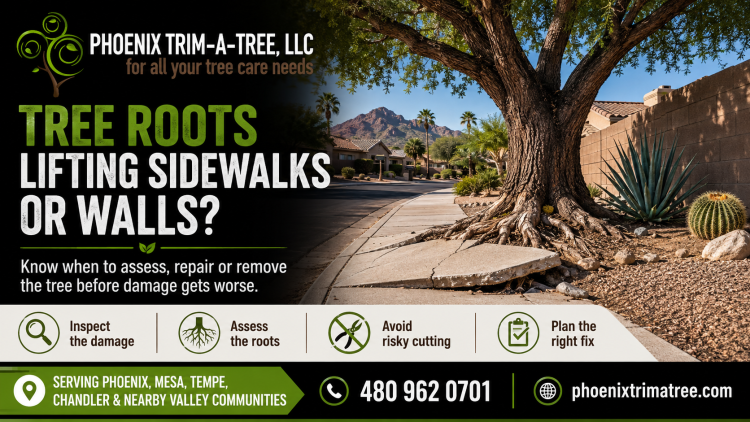
Tree Roots Lifting Sidewalks or Walls in Phoenix
Written by Craig B

Tree Roots Lifting Sidewalks or Walls in Phoenix

Tree Roots Lifting Sidewalks or Walls in Phoenix: What Should You Do?

A raised sidewalk slab or a crack through a block wall can turn a healthy shade tree into a difficult property decision. The visible damage may seem simple to fix, but the root beneath it may also help anchor and feed the tree. Cutting first and asking questions later can leave the tree stressed, unstable or more expensive to manage.

September is a useful time to inspect Phoenix properties after the hardest summer weather. Look closely at walkways, curbs, driveways, irrigation lines and walls near mature trees. Early assessment gives you more choices than waiting until a trip hazard or structural conflict becomes severe.

Why Roots and Hardscapes Come Into Conflict

Most tree roots spread outward through the upper soil rather than growing straight down. The University of Arizona describes tree root zones as wide and shallow, which matters when a large tree is planted in a narrow strip beside concrete. Caliche, compacted soil and limited planting areas can make the conflict worse.

As roots increase in diameter, they may lift a slab, push against edging or disturb a fence footing. Arizona ash trees are one local example known for surface roots that can lift curbs and sidewalks. The problem does not necessarily mean the tree is diseased. It often means the mature tree has outgrown the space allowed for its root system.

Inspect the Tree and the Damage Together

Do not judge the situation from the cracked concrete alone. Look at how close the damage is to the trunk, whether large roots are visible and whether the soil has lifted around the base. Check for a recent lean, cracks in the trunk, dead branches or thinning foliage.

The condition of the hardscape matters too. A slightly raised edge may allow more repair options than a wall that has shifted repeatedly. Mark the damaged area and photograph it so changes can be tracked. Where a public walkway or customer route is involved, the trip hazard may need prompt attention while the tree is assessed.

Why Cutting the Root Yourself Is Risky

A large root near the trunk may be structural. Removing it can reduce stability, particularly when the tree is already leaning or growing in restricted soil. Smaller roots also move water and nutrients, so repeated cutting can weaken the canopy.

Phoenix Trim A Tree explains that root cutting can injure or kill a tree depending on the size and location of the roots. There is no universal safe distance or root diameter for every species and site. Before digging, underground utilities and irrigation lines must also be located.

Possible Solutions Depend on the Site

The best solution may involve both an arborist and a concrete, masonry or landscape professional. Options can include adjusting the walkway, enlarging the planting opening, creating a gradual transition over a raised area or redesigning the space around the tree. Selective root pruning may be considered, but only after the effect on health and stability has been evaluated.

Root barriers are mainly a planning tool for new construction or replacement planting. They cannot undo years of conflict around an established tree, and installing one may damage roots already present.

When Removal Becomes the Practical Choice

Removal is not automatically required because a sidewalk has lifted. It becomes more likely when the tree is unstable, declining, repeatedly damaging important structures or occupying a space too small for its mature size. Repeated repair costs also need to be compared with removal and replacement.

When removal is chosen, include the stump and surface roots in the plan. Stump grinding can clear the immediate area for future landscaping or hardscape work, but the final repair should be coordinated with the contractor responsible for the new surface.

Schedule a Phoenix Tree and Root Assessment

Phoenix Trim A Tree provides residential and commercial tree assessment, trimming, removal and stump grinding throughout Phoenix, Scottsdale, Mesa, Tempe, Chandler and nearby Valley communities. When tree roots are lifting a sidewalk, driveway, curb or wall, call 480 962 0701 for a free estimate before cutting roots or beginning repairs.

Live References

University of Arizona: Choosing the Right Plants

University of Arizona: Plant Your Tree in the Right Location

Phoenix Trim A Tree: Will Cutting Tree Roots Kill the Tree?
Phoenix Trim A Tree: Arizona Ash Tree Trimming

Phoenix Trim A Tree: Stump Removal and Grinding

How-To-Tell-If-A-Tree-Is-Dead
Written by Craig B

Is My Tree Dead?

HOW TO TELL IF A TREE IS DEAD

GET A FREE ESTIMATE TODAY!

The easiest way to tell if your tree is dead is to take a knife or finger tip and scratch a twig. If it’s green your tree is still alive. If you love the look of trees in your landscape you likely can tell when something is off. There are ways to check to see if your tree is dead or if there’s a chance of saving it. In this post you’ll learn how to check if your tree is dead.

HOW TO TELL IF A TREE IS DEAD

While it’s normal for trees to shed their leaves each fall; it is harder to judge if it’s dead. Even stormed damaged trees aren’t necessarily goners. The biggest concern with dying or dead trees is the risk of them falling on homes or property.

STEPS TO TELL IF YOUR TREE IS DEAD

It’s possible to judge if your tree is still living or if sections or all of it have died. Follow these 4 easy steps to see if your tree is dead.

  • Snap a small twig off a low hanging branch and look for supple green flesh.
  • Test areas for life by scratching twigs and looking for that fresh green look.
  • Watch for sections of your tree that have decay or cankers.
  • Inspect the tree’s trunk for splitting, cracks, or bark falling off.
  • Watch for fungus or mushrooms growing around the base of the tree
  • Check the top of the tree for leaves that are deformed, hanging branches, or bald spots that have no leaves.

In the case that your tree has shown bad signs and might be dead it’s important to contact your local tree care company. Arborists can help you understand if your tree can be saved or if it poses a threat and you need tree removal services.

HOW DEAD TREES HARM PROPERTIES

Dead trees make your property look unkempt, but there’s more to it. Whether your property is residential or commercial the dangers are similar. There are 4 main dangers to having dead trees on your property.

  • Insect infested, or diseased trees can spread and kill other trees on your property.
  • Dead branches may fall and damage property or injure people without warning.
  • Dead trees can unexpectedly fall on buildings, vehicles, fences, or other valuable property.
  • Dead trees will attract unwanted pests like rats or termites and other insects.

If you’ve got a tree you think is dying or dead its critical to get it inspected and then saved or removed.

DYING & DEAD TREE SERVICES

If you’ve got a dying or dead tree it is time to act! Our arborist can help you inspect your tree to give an educated judgement on if it can be saved or if it’s too late. Trust the tree professionals in Phoenix at Phoenix Trim-A-Tree to help save your tree or keep your property safe by removing a serious risk to safety!

What-Is-A-Certified-Arborist
Written by webtechs

What Is A Certified Arborist?

WHAT IS A CERTIFIED ARBORIST?

GET A FREE ESTIMATE TODAY!

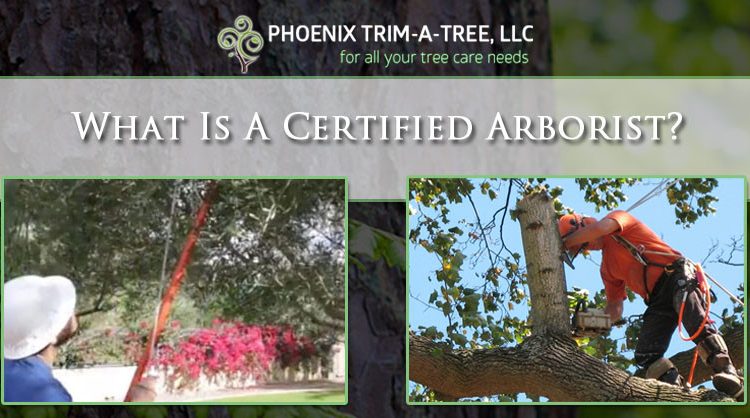
If you’re searching for “What is a Certified Arborist?” you’re likely either looking for tree services or you might be looking into a course of education. A Certified Arborist is a tree care professional who has been certified by the International Society of Arboriculture (ISA). This professional Credential is the result of college education along with passing exams conducted by the ISA. The benefit for business and homeowners is getting exceptional tree care by highly educated and professional Arborists.

WHY HIRE AN ARBORIST?

The definition of an arborist is “someone that has been trained and knows the arts and science about planting, taking care of, and, maintaining of different individual trees. An arborist is knowledgeable in regard to what it is that trees need, as well as trained and knows how to properly care for trees. Hiring an arborist is something one should take seriously.

Getting proper care for a tree could be an investment which could result in substantial returns. When a tree is properly cared for it will be more attractive, which in the long run will add a considerable amount of value to the property it is on. On the other hand, trees that have been poorly maintained could result in a liability. The pruning and/or removal of a tree (especially if they are huge) is very dangerous work. Only professionals that are properly equipped and have had the correct training to handle the removal of trees in a safe matter should be doing this kind of work.

WHAT EXACTLY IS A CERTIFIED ARBORIST?

Someone who has the level of knowledge in the art & science of caring for trees can get certified. An arborist will receive part of this knowledge through experience, part from reading and studying, and finally by taking and passing a very comprehensive examination being able to get certified. This comprehensive examination was developed by several of the most leading experts on caring for trees. Once someone has been certified as an arborist they have to maintain that certification by continuing to stay updated educationally and go by the Code of Ethics. This keeps them up to date with any new techniques as well.

To become a ISA Certified Arborist, one can join the process where individual people can measure the amount of knowledge and competence, which is required to be able to provide the proper care in caring for trees. The ISA Certification is not sponsored, nor is it endorsed by any government. It is the International Society of Arboriculture that handles the administering, this gives professional tree careers a chance to demonstrate how committed they are about this profession and the industry.

The certification is by no means a measure of standards of the practice. The certification is a way of knowing of an individual’s tree knowledge, however, a certification will not guarantee nor ensure of their performance being of quality.

PHOENIX VALLEY CERTIFIED ARBORIST

If you’re looking for service from an Certified Arborist we can help! Phoenix Trim-A-Tree’s Certified Arborist graduated from OSU and has the health of your trees in mind. When you want the best tree care possible you hire the certified professionals.

How-To-Tell-If-A-Tree-Is-Dead
Written by webtechs

How To Tell If A Tree Is Dead

HOW TO TELL IF A TREE IS DEAD

GET A FREE ESTIMATE TODAY!

The easiest way to tell if your tree is dead is to take a knife or finger tip and scratch a twig. If it’s green your tree is still alive. If you love the look of trees in your landscape you likely can tell when something is off. There are ways to check to see if your tree is dead or if there’s a chance of saving it. In this post you’ll learn how to check if your tree is dead.

HOW TO TELL IF A TREE IS DEAD

While it’s normal for trees to shed their leaves each fall; it is harder to judge if it’s dead. Even stormed damaged trees aren’t necessarily goners. The biggest concern with dying or dead trees is the risk of them falling on homes or property.

STEPS TO TELL IF YOUR TREE IS DEAD

It’s possible to judge if your tree is still living or if sections or all of it have died. Follow these 4 easy steps to see if your tree is dead.

  • Snap a small twig off a low hanging branch and look for supple green flesh.
  • Test areas for life by scratching twigs and looking for that fresh green look.
  • Watch for sections of your tree that have decay or cankers.
  • Inspect the tree’s trunk for splitting, cracks, or bark falling off.
  • Watch for fungus or mushrooms growing around the base of the tree
  • Check the top of the tree for leaves that are deformed, hanging branches, or bald spots that have no leaves.

In the case that your tree has shown bad signs and might be dead it’s important to contact your local tree care company. Arborists can help you understand if your tree can be saved or if it poses a threat and you need tree removal services.

HOW DEAD TREES HARM PROPERTIES

Dead trees make your property look unkempt, but there’s more to it. Whether your property is residential or commercial the dangers are similar. There are 4 main dangers to having dead trees on your property.

  • Insect infested, or diseased trees can spread and kill other trees on your property.
  • Dead branches may fall and damage property or injure people without warning.
  • Dead trees can unexpectedly fall on buildings, vehicles, fences, or other valuable property.
  • Dead trees will attract unwanted pests like rats or termites and other insects.

If you’ve got a tree you think is dying or dead its critical to get it inspected and then saved or removed.

DYING & DEAD TREE SERVICES

If you’ve got a dying or dead tree it is time to act! Our arborist can help you inspect your tree to give an educated judgement on if it can be saved or if it’s too late. Trust the tree professionals in Phoenix at Phoenix Trim-A-Tree to help save your tree or keep your property safe by removing a serious risk to safety!

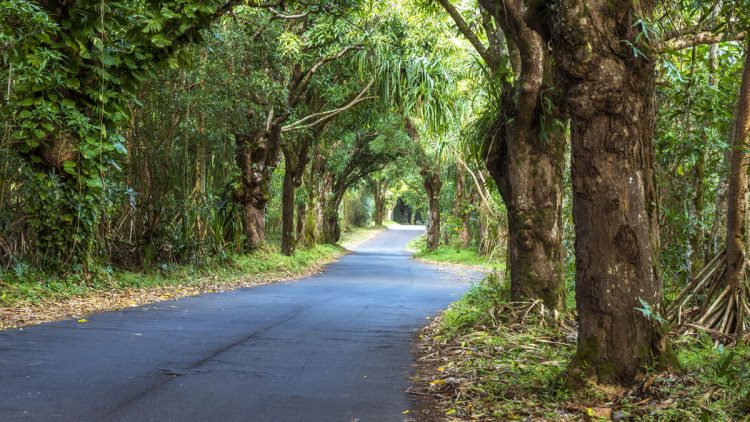
Canopy of trees over road
Written by webtechs

Fast Growing Shade Trees

FAST GROWING SHADE TREES

GET A FREE ESTIMATE TODAY!

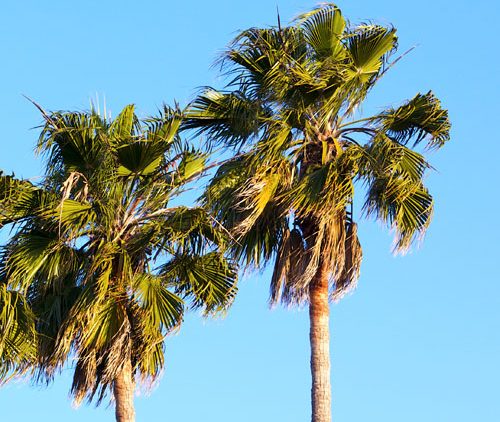
A lot of the residents in Arizona are wondering “Are Palm Trees Native To AZ?” Although there are thousands of palm trees to be seen around the Valley, most of those are not native of Arizona. The majority of palm trees are actually native of tropical climates, such as Florida, Southern California, South Carolina, and countries like Chile, Mexico, Peru, India, Australia, China, among others.

SISSOO

The Sissoo, or Indian Rosewood, is a fast-growing shade tree provide shade in a hurry. They grow to about 60’ in height and spread out wide to offer great shade to your landscape. As a semi-evergreen they add welcomed green to your desert landscape.

TIPU

The Tipu tree is loved by Arizona homeowners as it grows very quickly to its mature height of 40’ to 50’ feet. In addition to being a great shade tree, the Tipu has beautiful flowers and is a great addition to any residential or even commercial landscape.

ARIZONA ASH

The Arizona Ash tree grows fast, grows wide, and grows up to about 30’ tall. It’s a deciduous shade tree that will keep it’s leaves most of the year, especially during the hot months. That means that you’ll have plenty of new shade in a hurry with the Arizona Ash tree.

WEEPING WILLOW

The Weeping Willow, or Willow Acacia, has a unique shape and foliage that looks as if it’s streaming down. Its texture adds an interesting visual element to any landscape. It grows very quickly and reaches the maximum height of about 40’ much quicker than other common trees.

DESERT WILLOW

The Desert Willow is a favorite fast-growing shade tree by both homeowners and landscapers. This tree blows with beautiful pink or lavender flowers and grows quickly. As a broadleaf tree that reaches about 20’ in height it provides great shade and grows fast.

ELM

The Elm is a favorite tree just about anywhere you travel and can reach a mature height of 100’. It’s a hardy tree that can withstand wind, drought, full sun, but does need to be protected if there’s every flooding. The elms width and height provides excellent shade and grows quickly.

EVERGREEN PEAR

The Evergreen Peartree is a favorite in Arizona as it grows fast to its mature height of about 20’. This fast-growing shade tree is a great addition to your landscape as it has beautiful fragrant flowers in the spring time.

TREE TRIMMING AND REMOVAL SERVICES PHOENIX

Phoenix Trim-A-Tree offers tree removal and trimming services in Phoenix, Arizona as well as Scottsdale, Mesa, Tempe or Chandler, contact us today!

Palm Trees
Written by webtechs

Will Homeowners Insurance Pay For Tree Removal

WILL HOMEOWNERS INSURANCE PAY FOR TREE REMOVAL

GET A FREE ESTIMATE TODAY!

It depends on the circumstances. Home insurance does not cover the cost of removing a tree that has not yet fallen. You’re responsible for paying for general maintenance of your home and yard, such as pruning trees or removing a dying tree.

But if a tree fell in a storm and damaged the house, home insurance generally would pay for repairs to fix the damage and for removal of the tree.

What if the tree simply fell in the backyard without damaging any structures? Then, you would have to pick up the tab. Home insurance generally does not cover the removal of the tree unless it falls on a fence, garage or home and causes damage.

Sometimes home insurance will pay for removing a tree if it falls and blocks your driveway. Or, if you’re disabled, home insurance might pay if the tree blocks a wheelchair ramp. Check your home insurance policy or call your insurance agent for details. Typically, home insurance policies cover tree removal up to $1,000 per storm.

Call your town or city government to learn what to do if a tree from your yard falls into the street. Some municipalities will remove the tree, and others will require you to do it.

If a tree from your yard fell on a neighbor’s home, your neighbor would file a claim on his or her home insurance policy. But you could be held liable if the tree was dying and you had been warned about the hazard.

Don’t count on getting reimbursed for the value of a fallen tree. Some insurance companies don’t cover trees because they believe it’s too difficult to value landscaping. Others cover damage to landscaping up to 5 percent of a home’s value.

TREE TRIMMING AND REMOVAL SERVICES PHOENIX

Phoenix Trim-A-Tree offers tree removal and trimming services in Phoenix, Arizona as well as Scottsdale, Mesa, Tempe or Chandler, contact us today!

Canopy of trees over road
Written by webtechs

Overhanging Tree Branches

OVERHANGING TREE BRANCHES

GET A FREE ESTIMATE TODAY!

Trees are very beautiful but if they encroach or overhang the rood of your property they can become very problematic read on to learn more.

Look at the trees around your home on a yearly basis to ensure they are still alive and aren’t suffering from rot or disease. This will help you avoid dangerous scenarios, like an branch or tree crashing through a window or onto your roof.

A large tree branch can penetrate the roofing system, cause window breakage, and make it simple for animals to get into the home, and a host of other serious problems. Consider the following:

  • Tree branches leaning against the roof can scrape away the granules on asphalt shingles, greatly reducing their durability and overall lifespan.
  • Fallen leaves clog gutters and downspouts and trap moisture against the roof, which can lead to leaks, mold, and deterioration.
  • Excessive shade does not allow the roof to dry properly, causing mold and fungus growth.
  • If the tree and its branches are weak or diseased, heavy winds or a storm could cause branches or the entire tree to come crashing down onto the home.

As the damage potential is so great, one mistake in cutting may cause the entire tree or a very large branch to fall causing substantial damage to your residence. Therefore it is best to use the services of a professional trimming company!

TREE TRIMMING AND REMOVAL SERVICES PHOENIX

Phoenix Trim-A-Tree offers tree removal and trimming services in Phoenix, Arizona as well as Scottsdale, Mesa, Tempe or Chandler, contact us today!